
 This interview was also published on Jambands.com.
The Schwag is back. Vibe creators and Grateful Dead experience extraordinaires are making their triumphant return, with their tour touching down in Ohio, Illinois, Oklahoma, and Arkansas, as well as several shows in their home state of Missouri. From the beloved classics to the obscure, The Schwag takes audiences in many directions, all with a dynamic flavor and a touch of nostalgic flair.
After a 2010 raid of frontman Jimmy Tebeau’s property Camp Zoe, which was home to several annual festivals including the band’s own Schwagstock, Tebeau was held responsible and accused of maintaining a drug-involved premise. Despite getting sentenced to do 30 months in a federal prison, the star and his group’s following have stayed more true than ever. It seems the love will not fade away. He was recently released and The Schwag is just getting started on a big 2014-2015 tour, which will lead them all over the Midwest and beyond.
Tebeau took some time to discuss his long strange trip with me, opening up on a number of topics – from his musical journey to his recent release from incarceration.
Jimmy Tebeau: Oddly enough, me going to prison has made the band more popular. Now I’m officially an outlaw musician. Which is funny because I’m such a peace and love kind of guy. I hated it at first, but now I’m moving on. I’m out of the halfway house and I want to learn from this experience in any way shape or form. I can’t cry about it anymore. If life hands you lemons, you make lemonade.
Ellie Salrin: How does it feel to back on the road?
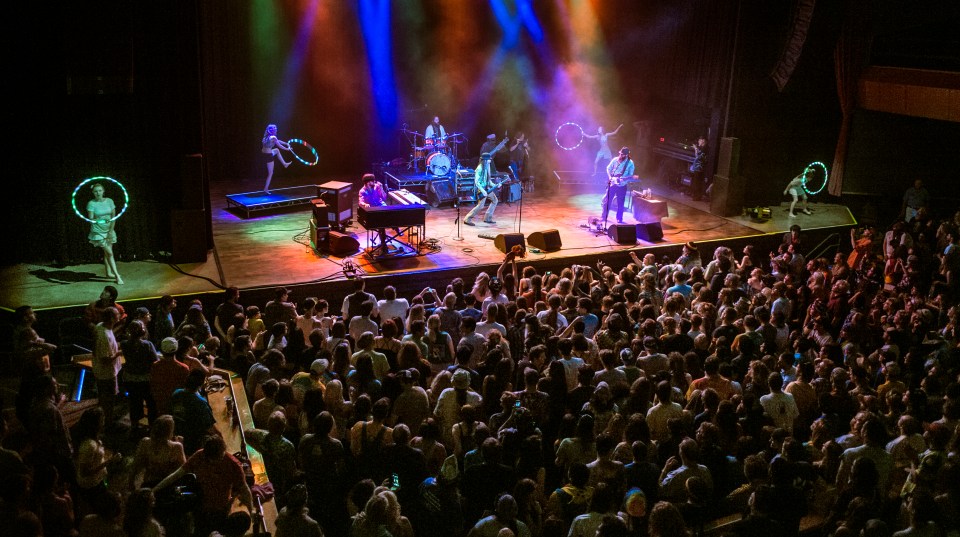
 JT: It’s so good…like a breath of fresh air. It was confining being in that prison; a federal prison camp in Yankton, South Dakota. I was there for about a year and then did several months in a halfway house. They let me play local shows when I was in the house. We did a big comeback show at The Pageant in St. Louis, which drew over 1,500 people. We did “Folsom Prison Blues,” which I changed to “Yankton Prison Blues”. We played “Wharf Rat,” and I got to say “I’m doin’ time for some other [person’s] crime”. So we had kind of a theme. And then one of those Saturdays, we got to open for Sammy Hagar at the Verizon Wireless Amphitheater, which holds 14,000 people. But for being in a halfway house, getting to do local shows was really cool. I don’t know if that’s ever happened before. September 9th, I signed out of the house and that night I played a gig in Chicago with the Furthur bus. We did six nights in a row and it was great. We also just did a big festival in Arkansas. All the shows have been hugely successful. The band is sounding better than ever and we’ve been rehearsing a lot. Not only are we back, but we’re playing even more songs than we had in the past. We’re bigger and better than ever and we’re ready. We’re excited to have this travelling musical circus back on the road.
I did four years in the Jerry Garcia Band before I was in prison. I’m not doing that gig anymore. I decided to do just one band and do it really well. I think that was part of my downfall – in two national touring bands and I owned a big, popular venue, was putting on all kinds of festivals and a few things got away from me. I had over 150 employees and things got crazy. I took the hit. Now I’m back. And it feels marvelous. I really reflected on what I’ve accomplished, where I’m at now, and where I want to go with it. I feel more focused than ever. It is like the phoenix rising, like I’m reborn and I’ve got a new outlook on life. I appreciate the gigs even more now. Every time I get on the stage, it’s another great, adventurous musical journey that I look forward to. There is this entire level of energy on stage. I have to look at the positives of the incarceration, and I’m utilizing that every day.
I learned a number of things while I was in there. I was with a number of white collared crime guys, as well as some high level drug dealers with non-violent history. I was in there with an electrical engineer who helped develop the Chevy Volt; he was accused of selling trade secrets to China. The man swore he was innocent. He was a complete genius. I was in there with a college professor that had two PHDs, who got caught up in some financial scandal that he was collateral damage of. I was in there with the director of the “Die Hard” movie with Bruce Willis, he was there for lying to a federal investigator. There was also a number of people who were caught coming across borders with something like 2,000 pounds of marijuana, had been doing it for years and got caught one time. It was a crazy mix of people. They influenced me, and who I am, because everyone is a product of their environment to a certain extent. It was quite an experience with these characters. I’m trying to take the positives from everyone I met in there. There were a number of guys with very bad attitudes, who I learned to avoid. They weren’t doing good time, they were doing bad time. It’s a crazy thing to say i’ve been to prison. I’d never thought I’d be saying something like that.
ES: How did you pass the time?
JT: I played a lot of music in there. They had a pretty big music department, which I got a job in. I had my own office and was teaching music. I would play for hours and hours every day. I was making quality use of my time. A lot of time for reflection. Peter Shapiro sent me a subscription to Relix magazine. I looked forward to getting it every month. I met Peter backstage at the Brooklyn Bowl. I’d played the Bowl and Capitol Theatre with Jerry Garcia Band; we probably played four or five times up there. I was getting tons of mail from all over too – California, New York, Hawaii, and even from Japan. That helped keep me going.
ES: How has the band changed since you have been released?
JT: We kind of re-branded…we’re calling ourselves the Grateful Dead Experience. We feel we’re more of an experience than a tribute band. When people come to our shows, we all experience something. It’s more of a journey we take together. We’re trying to evoke emotion at the shows. A feeling, an emotional catharsis, a release. We can take the audience down to complete silence during an emotional “Stella Blue” and then come back with a rousing version of “Lovelight” where everyone’s just screaming in complete elation. We get off on that. We all work together with the crowd; it’s not ever us and them. It’s all of us combining our conscious energy together. Tension release that the music creates. We’re making a career out of it and spreading the joy of love and music across the country and beyond. We’ve even had some international offers here lately for South America, Europe, the Philippines, and we’re looking at that for 2015.
ES: My mother introduced me to the Grateful Dead as a young child and the rest, as they say, was history. How did you come to love their music?
JT: That was in 1989. I was in a band at the time. We started out as a heavy metal band, which was what I listened to as a teenager. We were playing a lot of Judas Priest and Iron Maiden in the mid-80s. Then we learned that to make money and get more gigs we needed to play more Top 40-like stuff, so we moved into playing more hits of the day and we had a little Midwestern network we were running of small to medium clubs. Guns n Roses, “Wild Thing” by The Troggs, and stuff like that. In 1989, a friend of mine came to me with tickets for the Grateful Dead at Alpine Valley. I thought “Man, that’s a nine hour drive from St. Louis. And three nights? Do I need to go all three nights? Isn’t it the same show?” He said “Dude I got these tickets; we’re going”. So I went along. It sounded like a good time. I went out there, and I remember “Let the Good Times Roll” into “Feel Like A Stranger” with a big jam. I was blown away. I had no idea. By the third night, second set, they’re going into “The Other One” and putting all these crazy effects on top of the vocals, and the crowd was going nuts. At the end of that third night, I go up to the merchandise booth and buy a t-shirt, on the back of which was the tour dates. I see that the next venue they’re playing is in Sacramento, two weeks from then after a break. Then the Greek Theater in Berkeley. “That’s it,” I thought. “I’m going. I’m going to California.” I went to all three shows at Berkeley and then there was a week off. We drove down the coast and caught them in Los Angeles. I covered the whole left coast that summer of 1989. I saw as many shows as I could up until the end. I saw 77 shows with Jerry Garcia being in the Grateful Dead. I wish I would of caught more.
I’ve been a hardcore Deadhead ever since. I can’t burn out on the music at all. Sometimes I get the question, “Do you ever get tired of playing their songs?” The answer is “hell no”. It’s always fresh to me and we always do a little something different. Listening to the recordings is always fresh to me. I’ve seen them all over the U.S. It got me travelling, which made me want to get the band travelling more. In 1990 we started playing Grateful Dead music, and by 1991 I had landed the first gig. We didn’t even have enough songs. They wanted us to play nine…we didn’t have enough Dead material to fill the whole set. I remember we played “Eyes of the World.” Our first gig went over so well that they offered us a residency, where we played every Tuesday night at this little club in St. Louis. The club held maybe 80 people and their wasn’t even a stage. We just played in the corner. We did eight years of shows in that little corner. It was free to get in. That’s where we developed a bit of a following. The same people would come in every Tuesday so we had to branch out and learn more songs so we weren’t playing the same thing every week.
The club was so small, we could only do it as a three-piece band. So we were three people playing a six-piece band’s music and we blossomed from there. We called it The Schwag being another word for…maybe not the highest grade. We always were, and continue to be, very humble about what we do. We don’t claim to be the greatest band. We’re The Schwag. We’re not The Dead. We’re not recreating it. We’re just a few guys playing the songs, having fun, and we invite everyone to come have fun and jump in with us. Over the years we got better and better. We don’t have a Bobby guy; I sing a lot of the Bobby. We just rock it out. It is what it is. If you like it, that’s fine, if you don’t, that’s fine, too. There’s all kinds of other bands that are great, like Dark Star Orchestra. There’s no right or wrong way to play their music. I even do a solo acoustic show and I play the songs in my own weird way. It gives me a little more flexibility to switch it up on the spot . There are so many different ways to do it. It’s kind of like wine. Some people can drink Boone’s Farm and be real happy, where others are like, “Man this isn’t high-end enough!” There are some Deadheads like that. If you’re not with Phil Lesh or Bob Weir they’re, not interested. And that’s fine. To each his own.
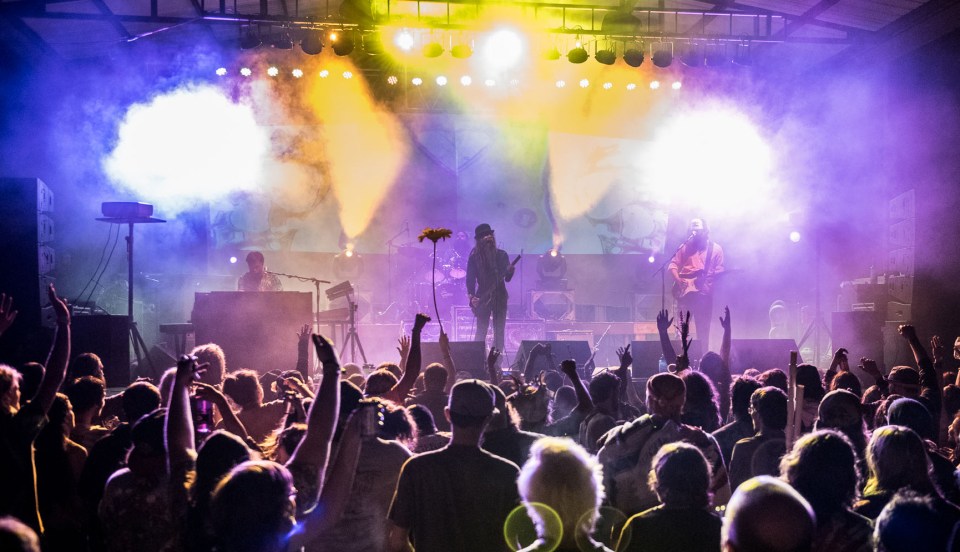
Now all of a sudden, it’s 2014. We’re trying to continue to make our music better. We like keeping the organic flavor of the music flowing. We’ll start one song and then we’ll decide to go into another one. There’s a number of shows we do where we go out there with no setlist. Me and the guitar player – he sings a lot of the songs as well – we’ll try to go back and forth where I’ll sing two or three in a row, then he’ll sing two or three. Sometimes we’ll just take turns.
ES: I love the dynamic you guys have on stage.
JT: There’s a certain level of comedy we’ve noticed lately. A certain amount of social interplay between us and the audience. We go on these musical adventures and sometimes we work ourselves into a dark alley and it’s like, “Oh, how we gonna get out of this one?” Or one of us will make a mistake on a chord and we all just laugh. We’re up there smiling and having a good time; it’s infectious throughout the whole venue. We get people smiling and laughing. We don’t wanna take it so seriously that it’s not fun. I’ve seen some bands play music and no one’s smiling the whole night. That’s our shit, that’s what we do, that’s what we enjoy. We’re not the highest dollar ticket out there, it’s not $30, $50, $100 to come see us. I always joked that Camp Zoe was like the Wal-Mart of festivals. We’re not the most expensive, and we deal in volume. We were like the bargain festival. You get a big bang for your buck. We had good production and lighting but it wasn’t over the top. We worked on a budget. We discussed hiring bands like Widespread Panic for two nights, but that would change the dynamic of what we set out to do.
ES: Without all of those huge names and a lot of money, so many people I know say that Camp Zoe changed their life. They have been touched by that experience; I was as well. Just being there, some of the simple things like projecting movies up on the bluff and having multiple events a year. It doesn’t always need to have all the bells and whistles to make it an experience for somebody.
JT: Exactly. We loved brainstorming little ways to make it better. Like showing those movies on the bluff – someone in the meeting was like, “That’s not gonna sell more tickets, why pay for that?” And I said, “Why not?” It adds a new element and vibe, and it was a simple thing to do. Let’s make it cool. We started doing a more electronic-influenced tent, which drew mostly younger people. Most of those DJs were doing it for a small fee, the PA system I owned. It’s not like it was a huge production cost, but it added something that some people really enjoyed and connected to. All the little things add up and add to the vibe. And in Camp Zoe, we always focused on the vibe. And that’s what we’re continuing to do with our travels, and every festival or event that hires us. We want it to be in line with our energy and our vibe. We always offer a number of suggestions, like “here’s a few things you can do to help create a good event.”
ES: What advice do you have for musicians aspiring to tour and reach a large audience?
JT: The advice I give is for them to understand that musical ability is half the game. Of course practice, practice, practice. Hone your musical skills. But the other half of the game is marketing, networking, and social compatibility. You have to get along with the people you’re playing with, and you have to get along with the people you’re working with. Always remain humble. I’ve learned that from Johnnie Johnson, who played with Chuck Berry. You always, no matter how popular you get, have to remain humble, grateful, and appreciative of every time you get to play. Don’t ever burn any bridges, no matter how big you get. The people you meet on the way up, you’re gonna meet on the way back down. In music, it’s not always an upward climb. There are peaks and valleys.
ES: I saw you playing “Redemption Song” on a radio show last month. What other music do you like to listen to and play besides the Grateful Dead’s music?
JT: I do love Bob Marley, as well as most reggae, including the obscure. I like Toots and the Maytals. When I go to concerts, I try leaning more towards really talented bands that have been around for awhile. Sometimes I will attend metal shows, bringing out that old metal head in me. We opened for Sammy Hagar recently, although I don’t find myself listening to a lot of that. I also like jazz. I’ll get into Miles Davis, Charlie Parker. I went to college for three and a half years and studied jazz while I was there. I played in the jazz big band, jazz combos, jazz quartet. I like really good bluegrass like Del McCoury Band, Yonder Mountain String Band, even Railroad Earth. I like seeing those guys. I enjoy String Cheese Incident; I’ve worked with several members of their band, who sat in for members of The Schwag.
Madison House, the management team and booking agent for String Cheese, approached me about getting three nights of String Cheese at Camp Zoe in 2006. They then did the Big Summer Classic in 2007, bringing in staging, lighting, and their own production. They did three nights of String Cheese, Los Lobos, Bassnectar, Infected Mushroom. Through that connection, I met the band members. The Schwag over the years has always been me and an ever-evolving cast of musical characters. Not that I meant for it to be that way. Things happen, people move on, get married and have kids, I’ve had two guitar players die. One died of a drug overdose and one died of cancer. At Schwagstock, I hired their two percussionists to play as The Schwag drummers for about four different Schwagstocks. And they’ve become friends of mine. Jason Hann showed up to Jerry Garcia Band shows. There was one event where I had the two drummers, Michael Kang, myself, and the keyboardist at the time. We did a five-piece band, and three members were actually from String Cheese, in my venue at my festival, and I was writing the checks. They’re so mellow and humble about it. I’m like, “Hey! You wanna do this? Here’s the song list.” They’d prepare in advance and do some homework. They’d come in on a Tuesday and we’d rehearse through Thursday, then play Friday and Saturday. We’d live together for a week, eat meals together, rehearse, play shows, do soundcheck, do two big sets in front of 5,000-plus people. It was The Schwag featuring Kang, Travis, and Hann. Those guys paid for themselves because they created extra ticket sales and it was a real joy playing with them. I felt that it brought up my level of musicianship, too, and really challenged me to bring it. Bill Nershi has sat in with us for a few songs. Even Chuck Berry has sat in with us in St. Louis. So has the drummer from Allman Brothers and Mike Gordon from Phish. We have had some fantastic company over the years – it’s been an endless music collaboration.
ES: If you could sit down and have dinner and conversation with one person, living or dead, who would it be?
JT: Jerry Garcia.
ES: What would you talk to him about?
JT: I would talk to him about music, perception of music, approach to music, his interpretation and his take. I’ve read a lot of interviews with him and was inspired. He was the catalyst of the band. The energy, the essence. It is more of the essence or the vibe that I’m trying to capture. He had some deep insight and I don’t know if a lot of people recognize that or not. I think we’d get into a metaphorical discussion. I like RatDog and I like Phil Lesh and Friends, but it is just nothing like when Jerry was there. With Jerry, he had “it.” That’s one of the things I got out of those shows. With the music and the chord changes, his overall approach always resonated so much with me. There’s no way I could ever re-create it or do it the way he did it, but I have somewhat of a basic understanding of what he was trying to do. We would enter into a deep discussion on that. I think we could talk about that for hours. I’d like to jam with the guy, too. I played for four years in Jerry Garcia Band with Melvin Seals, who played with Jerry for ten plus years. Some of that did rub off on Melvin and some of that rubbed off on me. I could see what Melvin was doing with the band; he was more of the musical director as far as picking some of the material and arrangements. Of course Jerry was a driving force and lead singer, but Melvin had a large amount of input. I learned a lot from Melvin.
ES: What is your outlook moving forward?
JT: Moving on from my time with the Jerry Garcia Band and my time being incarcerated, I am trying to stay really focused. Do what I love and do it well. I want to do what I’m passionate about and enjoy it to its fullest potential. I’ve been offered a number of jobs, where I’d make twice as much money for half the work. But it’s not doing what I want to be doing. Maybe other people are getting into music for money. But you gotta love what you do. That’s the American Dream, right? I love playing music, touring around, playing festivals. I have learned to be smarter about all the moves I make. I’m selective about how I spend my time, playing venues that are more organized, upping the whole level of promotion and production. If I’m gonna do it, I’m gonna do it as good as I know how to with my experiences and my resources.
This was just the beginning when it came to picking Tebeau’s brain. When the group came through my town, I was invited backstage to hang out with them while they created the setlist and rehearsed for their show that night. Kara Cavanaugh of Terrapin Flyer joined them to provide gracefully beautiful vocals. The time was a pleasant balance of laughter and songs to fill the air. The gentle musicians’ love of sharing music with others radiates from their souls.
See all The Schwag’s tour dates here.
 Ecstatic Magnolia